
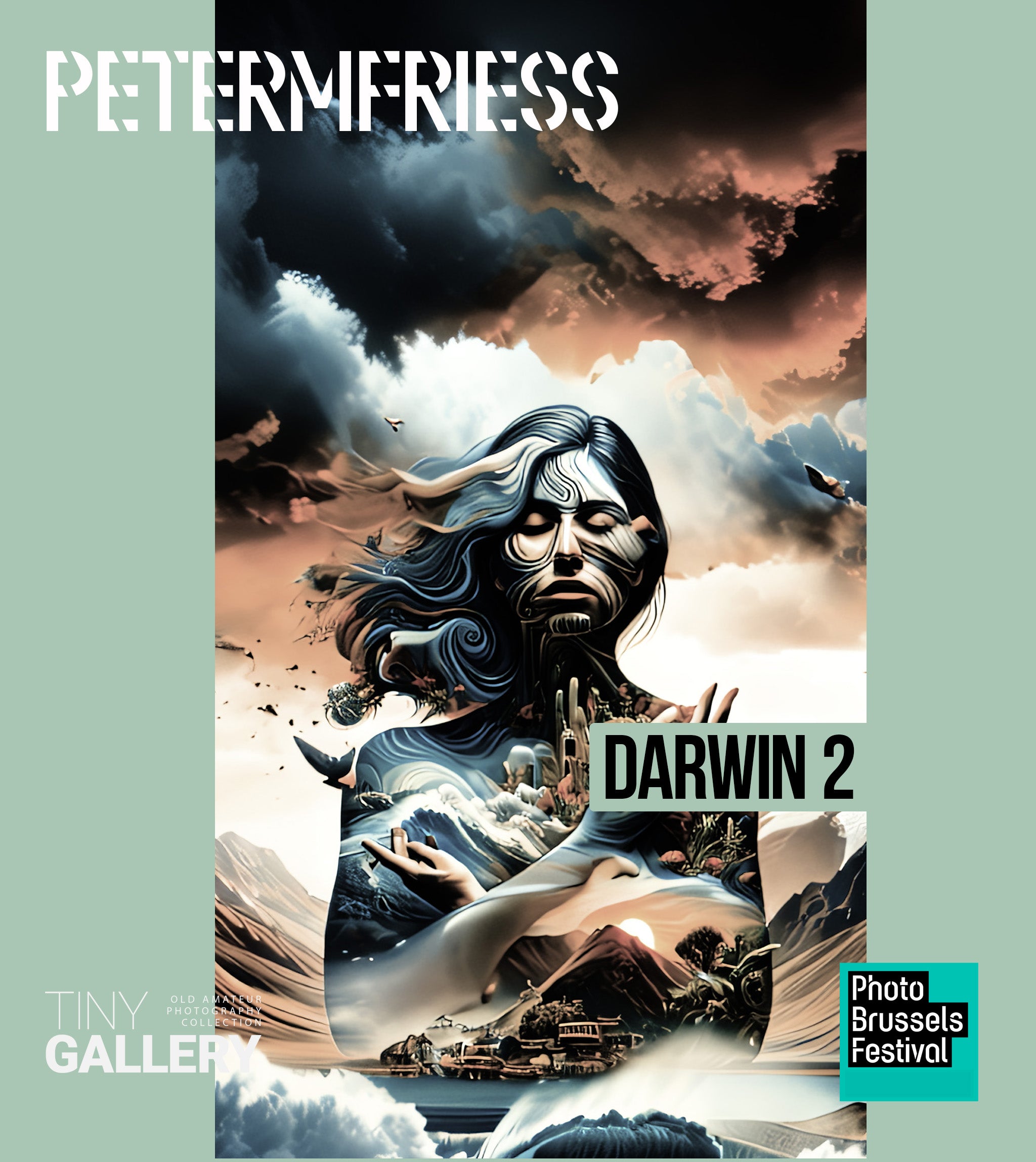
The Tiny Gallery in Brussels, as part of the current photo festival, presents itself as a space for innovation and reflection on the intersection between art, technology, and history. This venue, dedicated to photography, goes beyond traditional boundaries by integrating visual works created by artificial intelligence (AI), thus inviting a deep exploration of contemporary artistic possibilities.

At the heart of this exploration is the work "Darwin 2" by the artist Petermfriess. This piece represents a fascinating fusion between technology and art, illustrating how AI can not only imitate, but also extend human creative capabilities. Indeed, "Darwin 2" is not just a visual work; it is a meditation on the evolution of artistic creation in the digital age, a subtle and profound nod to Charles Darwin's theories of evolution.

In parallel, the calotype prints of the artist Olivier Guyaux remind us of the importance and beauty of historical photographic techniques. Calotypes, the ancestors of modern photography, represent an era where each image was the result of a handcrafted and chemical process. The juxtaposition of these works with AI creations like "Darwin 2" underscores a fascinating contrast between the old and the new, between the artist's hand and the computer's code.

By integrating these different forms of art, the Tiny Gallery stimulates profound reflection on the nature of artistic creation and the role of the artist in the era of artificial intelligence. This dialogue between past, present, and future offers visitors a unique experience, where the history of art blends with its future potential, thus challenging our perceptions and understanding of what art can be.

It is in this context that the Brussels photo festival acquires an additional dimension, becoming a fertile ground for the exploration of these new artistic frontiers, and inviting the public to reflect on the place of humans in art at a time when machines are beginning to play an increasingly predominant role in the creative process.

La Tiny Gallery à Brussels, dans le cadre du festival photo en cours, se présente comme un espace d’innovation et de réflexion sur les croisements entre l’art, la technologie et l’histoire. Ce lieu, dédié à la photographie, dépasse les frontières traditionnelles en intégrant des œuvres visuelles créées par l’intelligence artificielle (IA), invitant ainsi à une exploration approfondie des possibilités artistiques contemporaines.

Au cœur de cette exploration se trouve l’œuvre « Darwin 2 » de l’artiste Petermfriess. Cette pièce incarne une fusion fascinante entre technologie et art, illustrant comment l’IA peut non seulement imiter, mais aussi prolonger les capacités créatives humaines. En effet, « Darwin 2 » n’est pas une simple œuvre visuelle ; c’est une méditation sur l’évolution de la création artistique à l’ère numérique, un clin d’œil subtil et profond aux théories de l’évolution de Charles Darwin.

Parallèlement, les calotypes de l’artiste Olivier Guyaux rappellent l’importance et la beauté des techniques photographiques historiques. Le calotype, ancêtre de la photographie moderne, témoigne d’une époque où chaque image résultait d’un processus artisanal et chimique. La juxtaposition de ces œuvres avec des créations d’IA comme « Darwin 2 » met en évidence un contraste fascinant entre l’ancien et le nouveau, entre la main de l’artiste et le code de la machine.

En réunissant ces différentes formes d’art, la Tiny Gallery invite à une réflexion approfondie sur la nature de la création artistique et sur le rôle de l’artiste à l’ère de l’intelligence artificielle. Ce dialogue entre passé, présent et avenir offre aux visiteurs un moment singulier, où l’histoire de l’art se mêle à son potentiel futur, interrogeant ainsi nos perceptions et notre compréhension de ce que l’art peut être.

C’est dans ce contexte que le festival photo de Brussels prend une dimension supplémentaire, devenant un terrain fertile pour l’exploration de ces nouvelles frontières artistiques, et invitant le public à s’interroger sur la place de l’humain dans l’art à une époque où les machines commencent à jouer un rôle de plus en plus prépondérant dans le processus créatif.

De Tiny Gallery in Brussels presenteert zich, in het kader van het lopende fotofestival, als een ruimte voor vernieuwing en reflectie op het snijvlak van kunst, technologie en geschiedenis. Deze plek, gewijd aan fotografie, overstijgt de traditionele grenzen door visuele werken te integreren die met kunstmatige intelligentie (AI) zijn gecreëerd, en nodigt zo uit tot een diepgaande verkenning van hedendaagse artistieke mogelijkheden.

In het hart van deze verkenning staat het werk “Darwin 2” van de kunstenaar Petermfriess. Dit werk belichaamt een fascinerende versmelting van technologie en kunst, en toont hoe AI menselijke creatieve vermogens niet alleen kan nabootsen, maar ook kan verruimen. “Darwin 2” is dan ook geen louter visueel werk; het is een overpeinzing over de evolutie van artistieke creatie in het digitale tijdperk, een subtiele en doordachte knipoog naar Charles Darwins evolutietheorieën.

Tegelijkertijd herinneren de calotypieën van kunstenaar Olivier Guyaux ons aan het belang en de schoonheid van historische fotografische technieken. Calotypieën, de voorlopers van de moderne fotografie, getuigen van een tijd waarin elk beeld het resultaat was van een ambachtelijk en chemisch proces. De tegenstelling tussen deze werken en AI-creaties zoals “Darwin 2” onderstreept een boeiend contrast tussen oud en nieuw, tussen de hand van de kunstenaar en de code van de computer.

Door deze uiteenlopende kunstvormen samen te brengen, zet de Tiny Gallery aan tot een diepgaande reflectie op de aard van artistieke creatie en de rol van de kunstenaar in het tijdperk van kunstmatige intelligentie. Deze dialoog tussen verleden, heden en toekomst biedt de bezoeker een bijzondere ervaring, waarin de geschiedenis van de kunst zich vermengt met haar toekomstig potentieel, en zo onze percepties en ons begrip van wat kunst kan zijn op de proef stelt.

Het is in deze context dat het fotofestival van Brussels een extra dimensie krijgt, en uitgroeit tot een vruchtbare bodem voor de verkenning van deze nieuwe artistieke grenzen, terwijl het publiek wordt uitgenodigd na te denken over de plaats van de mens in de kunst, in een tijd waarin machines een steeds grotere rol beginnen te spelen in het creatieve proces.